Synopsis: After losing a powerful orb, Kara, Superman’s cousin, comes to Earth to retrieve it and instead finds herself up against a wicked witch.
Stars: Helen Slater, Faye Dunaway, Hart Bochner, Peter Cook, Mia Farrow, Brenda Vaccaro, Peter O’Toole, Marc McClure, Maureen Teefy
Director: Jeannot Szwarc
Rated: PG
Running Length: 105 minutes
Movie Review in Brief:
Supergirl Review: Camp, Chaos, and a Hero Worth Saving
Let’s rip the Band-Aid off right away.
1984’s Supergirl isn’t the trainwreck you’ve been led to believe it is. I honestly love this movie.
Not because it’s flawless. Please. The script has holes big enough for Kara Zor-El to fly through without ducking. The villain’s master plan is shaky, the mythology changes whenever someone in the editing room gets nervous, and there are moments where you can practically hear the budget coughing from exhaustion. But Supergirl has something far more valuable than perfection. It has personality.
It also arrived with the bad luck of being tied to a franchise already wobbling. Superman III had taken a big swing toward slapstick weirdness and left audiences unsure what this universe was supposed to be anymore. Supergirl entered the picture after that awkwardness, carrying franchise expectations, production headaches, budget questions, and the additional burden of being the first major female-led superhero movie on this scale. That’s a lot to hang on a 19-year-old making her feature debut.
Helen Slater, bless her cape, carries it anyway.
The Girl of Steel Arrives
Slater’s performance is the reason Supergirl still works. She plays Kara with a wide-eyed sincerity that would be easy to mock if it weren’t so disarming. This isn’t a knowing, quippy, modern superhero performance. Kara isn’t winking at the audience. She isn’t embarrassed by the costume. She isn’t trying to announce herself as cool.
She’s discovering everything.
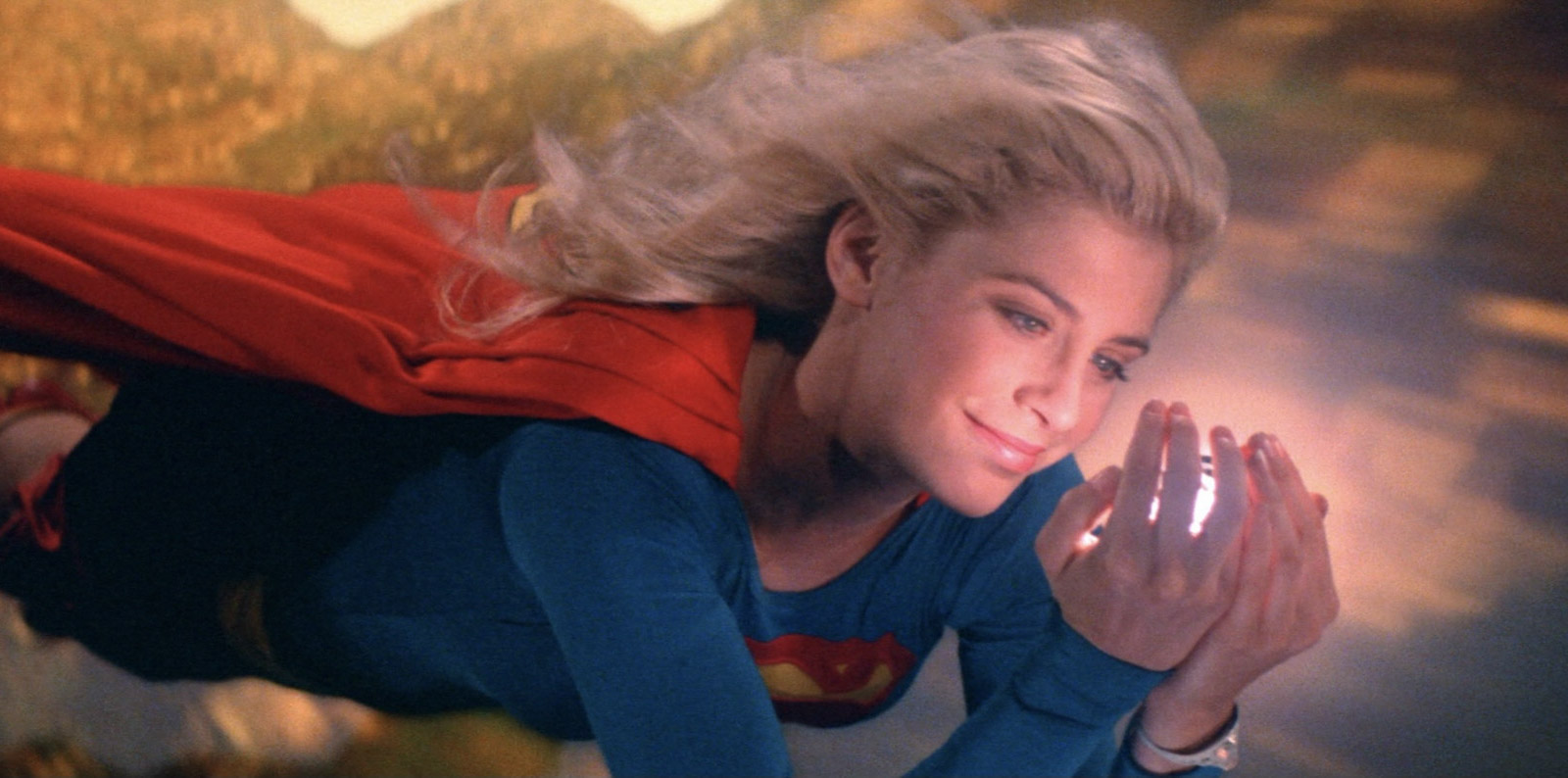
That sense of wonder gives the movie its pulse. When Kara arrives on Earth and experiences flight, flowers, school uniforms, crushes, and human awkwardness, Slater treats each new encounter like it matters. The flying scenes remain some of the film’s strongest sequences because she sells the emotional reality of them. She looks like someone who loves being in the air.
There’s a grace to her physicality that the film wisely leans on. Even when the effects show their age, Slater gives the illusion weight. Or maybe anti-weight. You know what I mean.
The plot begins in Argo City, where Kara accidentally loses the Omegahedron, the powerful orb that keeps her world alive. It lands on Earth, falls into the hands of Faye Dunaway‘s would-be witch Selena, and sends Kara after it. Does all of this make sense? Not especially. Do I care? Also not especially.
Faye Dunaway Chooses Violence, Theatrically
Every superhero needs a villain. Supergirl gets Selena, and Selena gets Faye Dunaway. This is both a blessing and a warning label.
Dunaway has been mocked for years for going over the top here, but let’s be honest: what top? The movie gives her an abandoned amusement park lair, a magical orb, Brenda Vaccaro as a sidekick, Peter Cook floating through the edges as a warlock, and a romantic obsession with a hunky, often-shirtless gardener named Ethan (Hart Bochner, Die Hard). There’s no grounded version of this character. Dunaway simply looked at the material, saw there was no ceiling, and brought a ladder anyway.
I admire that.
Selena’s plan for world domination is hilariously underdeveloped. She mostly seems interested in making Ethan love her and occasionally terrorizing the small town of Midvale. As comic-book villainy goes, this is less “kneel before Zod” and more “my crush liked someone else’s Instagram photo.” Still, Dunaway attacks every line with full operatic commitment, and Vaccaro is often funnier than the movie seems to realize.
The silliness is part of the charm. Supergirl gestures toward the Christopher Reeve films but never really feels at home beside them. It’s brighter, stranger, cheaper-looking in places, and far more enchanted by its own oddness.
Zaltar, Lucy Lane, and the Last Tie to Superman
Then there’s Peter O’Toole as Zaltar, Kara’s mentor and the man whose carelessness with the Omegahedron sets the whole story going. O’Toole could’ve collected a paycheck and gone home. He doesn’t. He gives Zaltar a wounded, slightly tipsy grandeur, like a classically trained giant who wandered onto a comic-book set and chose to take it seriously.
His best work comes later, once the story strands him and Kara in the Phantom Zone. It’s a bleak gray nowhere of mud, wind, and broken rock. Those scenes have no business landing the way they do. Two lost souls stand in a wasteland and talk about failure, regret, and the will to keep going. It plays less like a superhero movie than like Shakespeare staged in a vacant lot. Or maybe Samuel Beckett, if Beckett had a soft spot for capes. Slater rises to meet him, and O’Toole hands the film its only real gravity.
The Earth-bound supporting cast does more for the movie than it usually gets credit for. Maureen Teefy (Fame, Grease 2) plays Lucy Lane, kid sister of a certain Daily Planet reporter. She’s Kara’s college roommate and first true friend. Teefy gives Lucy real warmth and a quick comic rhythm, and she keeps the Midvale scenes feeling human while everything around them gets sillier. She’s also why Kara’s fish-out-of-water act works. She makes alter ego Linda Lee read like an actual teenager instead of a visiting goddess.
And then there’s Marc McClure as Jimmy Olsen, the film’s only direct handshake with the Reeve era. Reeve’s planned Superman cameo was cut before release, which leaves McClure’s eager, good-natured Jimmy as the lone bridge to the four Superman films around it. He’s the only actor to appear in all of them, and there’s something perfect about that. The supposed throwaway comic-relief guy turns out to be the thread that stitches the whole universe together.
Big Names, Big Ambitions, Big Problems
The producers clearly wanted Supergirl to feel like an event. They surrounded Slater with heavy hitters: Dunaway, O’Toole, Mia Farrow, Vaccaro, Cook. The strategy was obvious and not unlike the casting of Marlon Brando in Superman: The Movie. Give the newcomer prestige armor. Make the audience feel they’re watching something important.
You can see the money on screen in some places, especially in the flying work and the large-scale fantasy design. You can also see the strain. Argo City looks dreamy one moment and like a showroom display the next. Some effects have aged better than others. The Phantom Zone material has a wonderfully bizarre, almost Flash Gordon-adjacent energy that may or may not have been intentional.
The million-dollar opening credits alone were treated like a major production statement, and the film keeps reaching for grandeur even when the script is holding it back by the cape.
Director Jeannot Szwarc, who had previously made Jaws 2, does what he can to keep the movie moving. His best instincts involve Slater’s physical presence and the romance of flight. His biggest challenge is a screenplay that can’t decide how much Kara knows, how her powers work, what Selena actually wants, or how seriously any of this should be taken.
The result is messy. It’s also unabashedly rewatchable.
The Music Knows Exactly What Movie This Is
If there is one element of Supergirl that never wavers, it is Jerry Goldsmith’s score. Where the script hesitates and the tone shifts from scene to scene, the music stays locked in. Goldsmith gives Kara a sweeping, romantic theme that treats her like the hero the movie sometimes struggles to define on its own. The score does not wink. It does not apologize. It soars.
That confidence matters. It bridges the film’s tonal gaps, smoothing over the jumps between fairy tale, camp comedy, and superhero adventure. In moments where the effects show their age or the editing feels uncertain, the music insists on high stakes glory anyway.
The rest of the craft follows that same instinct, even if less consistently. The flying works because Slater sells it, yes, but also because the filmmaking leans into movement and joy over technical perfection. The practical effects are simple, occasionally charmingly so, and the film finds small visual tricks—like Kara’s transformations happening in motion—that feel more magical than mechanical.
Even the costume design plays into that sense of identity. Supergirl’s bright, primary colors cut cleanly through the softer, more earthbound palette around her. She looks like she belongs to a different story. In some ways, she does.
A Cult Movie With Multiple Lives
Part of Supergirl‘s legend comes from its many versions. The U.S. theatrical cut, the longer international cut, television edits, and extended presentations have turned the film into a small-scale editing mystery. Scenes appear and disappear. Music cues shift. Dialogue changes. Fans have spent years arguing over which version best represents what the movie was supposed to be.
That complicated history fits. Supergirl has always seemed like a movie caught between intentions. Is it a fairy tale? A comic-book adventure? A camp fantasy? A franchise extension? A coming-of-age story? Yes, sort of, depending on the scene.
Watching it now, especially with superhero cinema having become such an industrial machine, Supergirl feels oddly refreshing. It’s handmade in ways both beautiful and clumsy. You see the wires. You see the seams. You see a movie trying to build wonder without a corporate universe map pinned to the wall.
Why It Still Matters
Supergirl deserves recognition not because it was first, though that matters, but because it dared to be sincere at a time when female superheroes weren’t being treated as safe bets. The film didn’t get the support, timing, or script it needed. It also didn’t get the grace many flawed male-led superhero films have been granted over the years.
Helen Slater gave audiences a Kara who was brave, curious, kind, and a little strange. That performance has endured because it understands something essential about the character: Supergirl isn’t just Superman with a skirt. She’s someone displaced from home, forced to grow up quickly, learning how to be powerful without losing softness.
As the character continues to be revived, rebooted, reintroduced, and reimagined, it’s worth going back to this original big-screen version with kinder eyes. Supergirl is campy, silly, uneven, and occasionally ridiculous. It’s also charming, funny, visually ambitious, and powered by one of the most appealing superhero debuts of the decade.
Give it another Flight
Supergirl is not a perfect superhero movie. It may not even be a particularly good one by traditional measurements. But traditional measurements are boring, and this movie is not. Helen Slater gives it sincerity, Faye Dunaway gives it theatrical madness, and the whole thing has a fizzy cult-movie energy that makes its flaws part of the fun. History has been too hard on Supergirl. I’m here to say she deserves better.
Looking for something? Search for it here! Try an actor, movie, director, genre, or keyword!
