Soldier (1998) 4K Review: A Man of Few Words
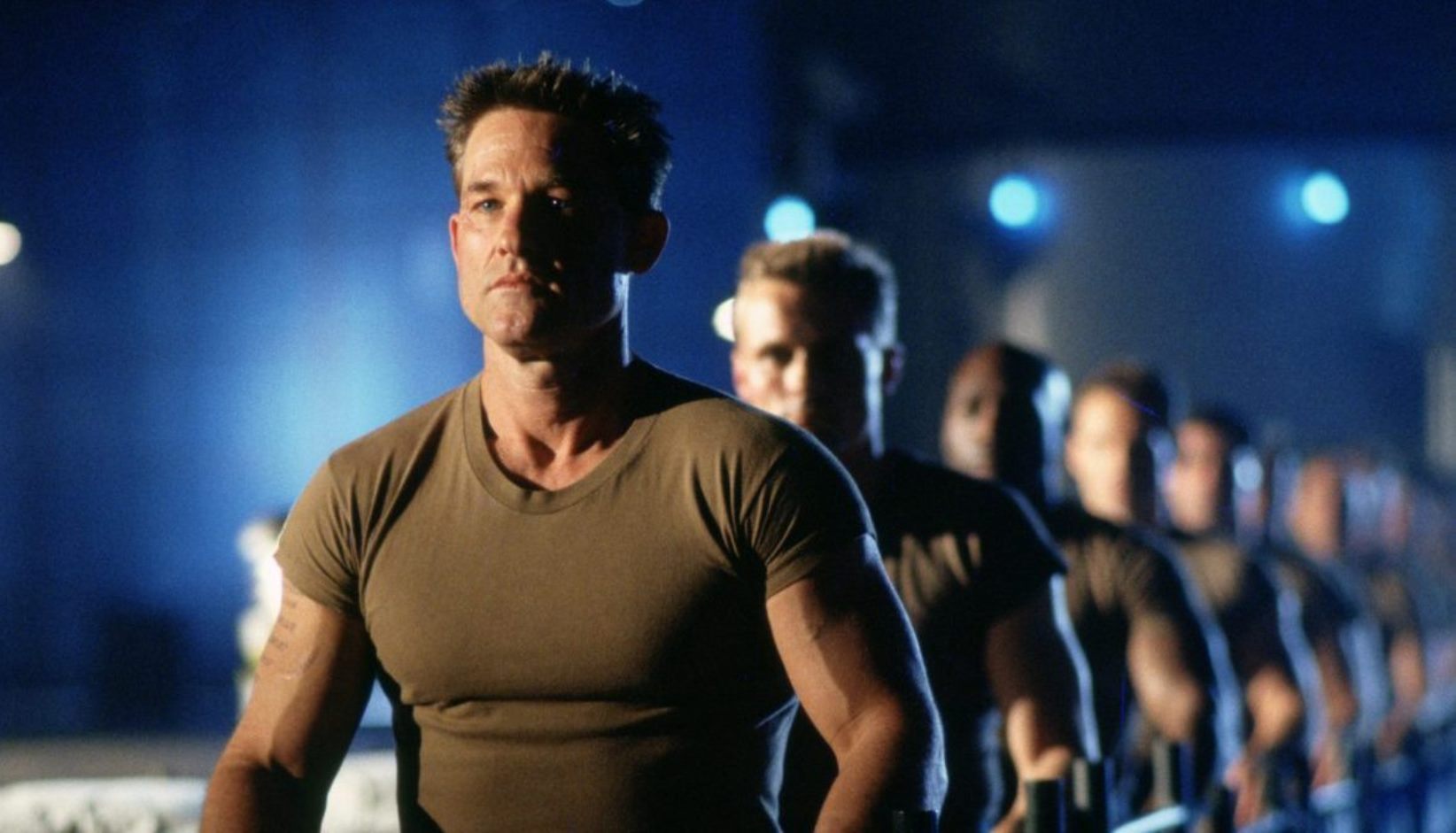
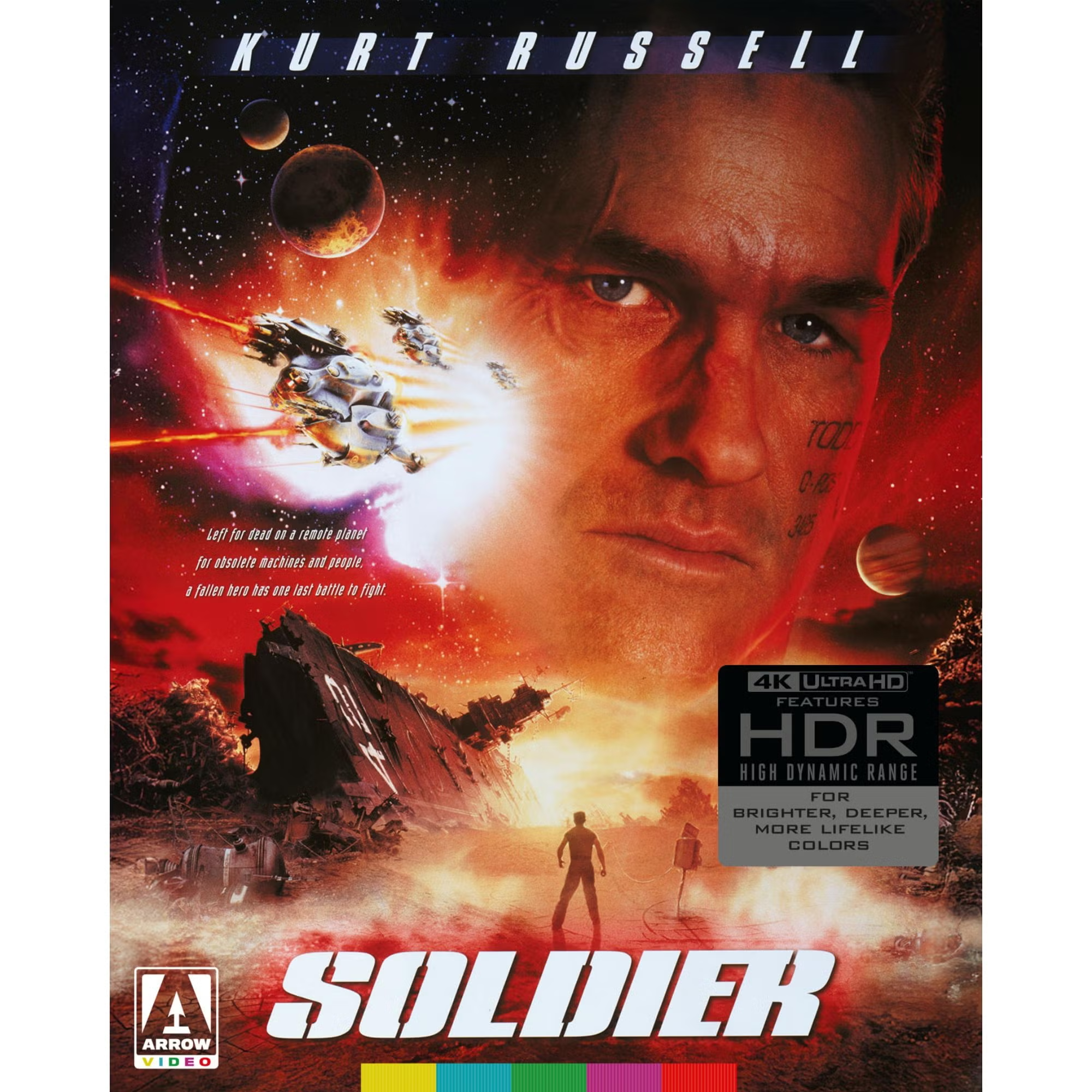
Synopsis: Bred for war. Discarded like trash. Dumped on a junkyard planet at the edge of nowhere, an obsolete soldier learns something his training never allowed. Then the men who replaced him arrive, and he remembers exactly what he was built to do.
Stars: Kurt Russell, Jason Scott Lee, Jason Isaacs
Director: Paul W.S. Anderson
Rated: R
Running Length: 96 minutes
Movie Review in Brief: Arrow Video’s Soldier 4K UHD Limited Edition restores Paul W.S. Anderson’s 1998 Blade Runner sidequel with Dolby Vision and a stacked extras suite. A film for Completionists, with a disc that argues for cult-classic status anyway.

David Webb Peoples wrote Blade Runner. He also wrote Soldier, intentionally, as what he called a “side-quel” set in the same fictional universe. Spinners from Blade Runner show up in the garbage pile. Tannhauser Gate and Shoulder of Orion appear on the protagonist’s combat record. The Nexus-9 implication runs through every frame of Paul W.S. Anderson‘s 1998 sci-fi action piece, the premise itself spun out of an unused Blade Runner opening scene in which a group of Replicants are dumped on an off-world colony. Arrow Video’s new 4K release argues the film deserves a second look, even as the film itself argues against that idea more than half the time.

Sergeant Todd 3465 (Kurt Russell, The Hateful Eight) is the end of a line. Raised from infancy as a remorseless killing machine, he’s deemed obsolete when Colonel Mekum (Jason Isaacs, Juliet & Romeo) rolls out a new generation of genetically engineered soldiers led by Caine 607 (Jason Scott Lee, Lilo & Stitch). Todd loses a brawl, gets dumped on a waste-disposal planet, and finds himself living among the colonist hippies who collect the galaxy’s garbage. He reconnects with his lost humanity in the third act, the new soldiers come hunting, and Todd reawakens the warrior within. Sean Pertwee and Connie Nielsen lead the colonists. Gary Busey shows up as Mekum’s old-guard counterpart and a young Corbin Bleu has a tiny role as a colony kid. Russell speaks 104 words across the entire film.
The path to that final film was nearly two decades long. Peoples started the script around the time Blade Runner was filming. Ted Kotcheff and Sylvester Stallone were attached after First Blood. Schwarzenegger circled it after Commando. Clint Eastwood signed on to star and direct around the time of Heartbreak Ridge. Each version collapsed. By the time Anderson and Russell finally got it made in 1998, Russell had spent eighteen months bulking up for the role—working out three to four hours a day, refusing steroids, pushing production back so long that Anderson made Event Horizon in the meantime.
Russell broke an ankle in the first week of filming after tripping over an ornamental cabbage during a break (the press release blamed a stunt). The shoot had to be reordered around him: lying-down scenes first, then sitting, then standing, then running. El Niño storms killed Anderson’s plan to shoot on wide-open existing locations, forcing the production onto soundstages around Los Angeles. Anderson has openly said the film didn’t turn out the way he wanted. (No kidding!)
The result is…uneven. Anderson and Peoples conceived it as “Shane in space”, and that DNA shows in the third-act stand to defend the colonists. The problem is the first hour, where the film keeps reaching for solemnity it hasn’t earned and a star turn Russell has decided not to give. The performance isn’t Snake Plissken. It’s barely a performance at all—a blank face, a beefed-up frame, and the occasional clipped syllable. Jason Scott Lee gets even less to do. It takes a certain type of action star to command a screen without much dialogue and only a select few (like a Schwarznegger, for instance) can pull it off.
What works, works late. The final third finds the right register of pulpy violence and unembarrassed B-movie pleasure. The death-trap defense of the colony plays. Russell killing nasty creatures and a cavalcade of extras is exactly the film Soldier should have been all along. Anderson would figure out how to balance that tone consistently a few years later with Resident Evil. Soldier is the stumble that taught him how. The film is worth rediscovering for the reasons it works, and for the reasons it doesn’t.
Russell, by the way, was paid $20 million for the role—six million more than the film grossed in the entire US theatrical run.

Arrow’s new 4K restoration is approved by Anderson himself and arrives in Dolby Vision with HDR10 compatibility at the original 2.39:1 aspect ratio. The image is flawless throughout, with David Tattersall‘s widescreen cinematography sharper and more dimensional than any previous home release. Color reproduction is strong, blacks are deep without crushing, and the soundstage-bound production design that frustrated Anderson at the time now reads as more deliberate than it ever has. Region free.
Audio comes in DTS-HD MA 5.1 surround and a stereo track. The 5.1 is the pick. Joel McNeely‘s score gets directional clarity, and the effects work in the final battle—crawlers, explosions, the constant percussion of automatic weapons—surrounds the room without overwhelming dialogue.

The archival commentary with Anderson, co-producer Jeremy Bolt, and Jason Isaacs is the legacy track, and it’s a relaxed, conversational walk through the production—the Blade Runner connections, the Russell ankle saga, the R-rating fight after the MPAA initially handed down an NC-17 over a grody eye-gouge. Isaacs doesn’t arrive until halfway through, but his presence livens the second half considerably.
The new interviews are the centerpiece. Actor James Black (Riley), assistant director Dennis Maguire, and associate producer Fred Fontana cover the production from inside the trenches. Production designer David L. Snyder—who came to Soldier off the Blade Runner lineage that Peoples and Anderson were actively chasing—gets a proper interview about how that visual continuity was built.
Visual effects supervisors Craig Barron and Van Ling and miniature supervisor Michael Joyce sit for Weapons of Mass Creation, an unusually substantive piece on the practical-and-digital hybrid effects work, paired with Barron’s separate VFX Before and After breakdown. A Soldier’s Journey gives author Danny Stewart space to discuss his book Soldier: From Script to Screen, and film historian Heath Holland’s We Don’t Need Another Hero makes the case for the cult reappraisal that this disc itself is part of.
Round it out with the original electronic press kit, on-set interviews with the full cast (Russell, Busey, Lee, Michael Chiklis, Nielsen, Anderson, and producer Jerry Weintraub), six different theatrical trailers including the workprint teaser, and a 211-image gallery. A reversible sleeve and a collectors’ booklet with new writing by critic Priscilla Page complete the set.

Shelf Worthy for cult-cinema completists and Blade Runner universe-builders; Stream First for everyone else. Arrow has given Soldier the deluxe treatment it never earned theatrically, and the extras package alone makes a stronger case for the film than the film ever made for itself.
Looking for something? Search for it here! Try an actor, movie, director, genre, or keyword!
The MN Movie Man
Spoiler-free film critic on a mission to ensure your cinematic experience is unforgettable. Let's dive into the magic of movies together!
Subscribe now to keep reading and get access to the full archive.


Leave a Reply