Synopsis:As a massive government conspiracy unravels, a targeted whistleblower races against time to bring about the extraordinary event that will change human history forever: the day of ultimate alien disclosure.
Stars:Emily Blunt, Josh O’Connor, Colin Firth, Eve Hewson, Colman Domingo, Wyatt Russell, Elizabeth Marvel
Director:Steven Spielberg
Rated:PG-13
Running Length:145 minutes
Movie Review in Brief:Spielberg’s first film in four years is a big-swing UFO thriller that hides real heart inside the spectacle. Blunt is astonishing, Williams is reborn, and the less you know going in, the better,
Close Encounters of the Best Kind
For the first time in four years, Steven Spielberg is pointing his camera back at the sky, and it feels like an event. His last film, The Fabelmans, was a tender but oddly subdued memoir. Watching him swing this big again is a thrill. That’s what I was left with at the end of Disclosure Day, with simple relief that the guy who invented the summer blockbuster still knows how to build one. And this time he packed it with real ideas.
Spielberg Finally Looks Up Again
Here’s the pitch, and I’ll keep it as spoiler-free as possible. A sprawling government cover-up begins to crack, and a hunted whistleblower scrambles to bring about the moment the title promises: proof, shown to all eight billion of us, that we are not alone. Spielberg dreamed up the story himself, then handed it to screenwriter David Koepp (Presence, Black Bag), who reportedly wrote 42 drafts before they had it. You can feel the labor. Disclosure Day wears the DNA of a paranoid 1970s thriller like The Parallax View, all moving parts and shifting loyalties, and nobody stages that kind of chaos better.
This is Koepp’s fifth script for Spielberg, after Jurassic Park, War of the Worlds, and Indiana Jones and the Kingdom of the Crystal Skull. Those two clearly know each other’s rhythms by now.
Spielberg keeps circling this subject. He turned first contact into wonder with Close Encounters of the Third Kind and E.T. the Extra-Terrestrial, then into nightmare with War of the Worlds. He calls Disclosure Day a bookend to Close Encounters, and that tracks. The difference is the question. The old films asked whether “they” were out there. This one asks what happens to us once we know for sure, and whether the people sitting on the answer have any right to keep it.
A Conspiracy Worth Protecting
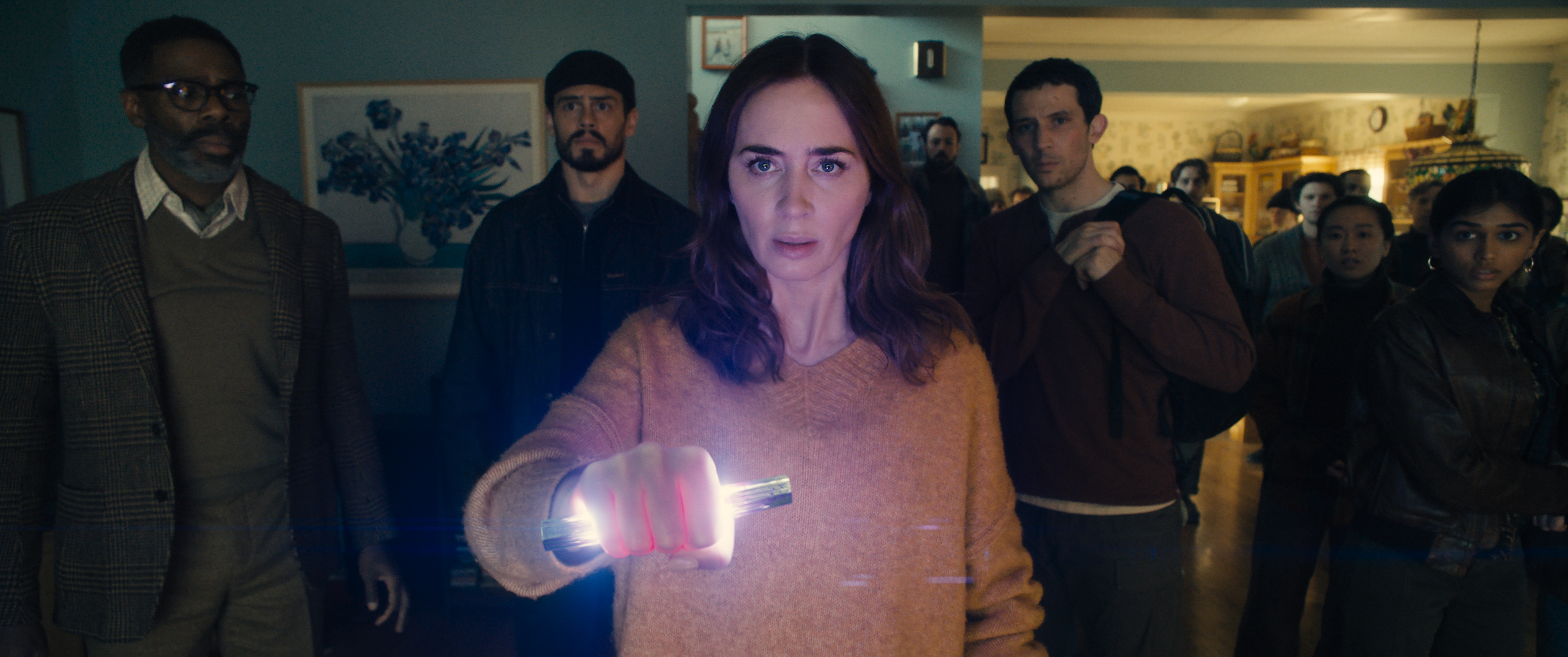
The story drops you straight into the deep end. Spielberg trusts the cast to orient you fast: who these people are, who to trust, who’s lying. Margaret Fairchild (Emily Blunt, Oppenheimer) is a Kansas City TV meteorologist itching for a bigger gig, to the mild frustration of her boyfriend Jackson (Wyatt Russell, The Falcon and the Winter Soldier). Then a stray cardinal flutters into their sunny loft and wakes something dormant in her. From there, her life changes irrevocably.
On the other side sits Daniel Kellner (Josh O’Connor, Challengers), a hacker turned cybersecurity man for WARDEX, a shadow outfit guarding decades of evidence about visitors. He bolts with the goods, which makes him either the hero or the villain, and for a good while you honestly can’t tell. His old boss Noah Scanlon (Colin Firth, Supernova) wants him stopped. A defector named Hugo Wakefield (Colman Domingo, Rustin) wants him to run. Daniel’s girlfriend, ex-nun Jane Blankenship (Eve Hewson, Papillon), gets grabbed as leverage. That’s all you get from me. Anyone who tips you off to where the third act lands deserves to be beamed into the nearest black hole.
The Cast That Sells the Impossible
I’ll be honest: early on I worried Blunt was playing Margaret too light, too airy. That worry evaporated. The airiness is the on-ramp to her awakening, and the change she pulls off is astounding. She keeps finding new gears this deep into her career, which feels almost unfair to everyone else working. Blunt doesn’t just carry Disclosure Day, she levitates it.
O’Connor’s star wattage keeps climbing, and he’s ideal as a man who’s a mystery even to himself. He and Blunt move through a tricky second act with total command, dragging us across some thorny, far-fetched terrain that lesser actors would have fumbled. And yes, parts of the movie get creaky and convenient. It still goes down easy, because everyone on screen commits so fully. Hewson, whose rise I’ve loved tracking, gives Jane real spine. Domingo brings a sincerity that sneaks up on you, and he owns one of the film’s very best scenes.
My one real reservation is Firth. Scanlon is supposed to be unlikable, fine, but there’s character discomfort and then there’s an actor who never settles into a role. Firth, dressed head to toe in black with a permanent sneer, lands in the second camp for me. The casting is otherwise immaculate, top to bottom, thanks to Cindy Tolan. She stocks the film with fresh New York and Broadway faces, and the unfamiliarity adds a jolt of believability. Even former news anchor turned actor Courtney Grace gets a terrific late beat that leans on both of her skill sets at once.
Kaminski's Camera and the Williams Surprise
This is the 21st film Janusz Kaminski has shot for Spielberg, going back to Schindler’s List, and the shorthand between them is something to behold. Kaminski can hold a small, intimate two-hander one minute and unleash pure mayhem the next. There’s a car chase that starts modest and balloons out of control, and at some point you realize you’ve stopped breathing. That’s the gift of two people who can stage a set piece in their sleep.
Editor Sarah Broshar keeps all 145 minutes flying. (A fun bit of trivia: this is Spielberg’s first film since E.T. not cut by his longtime editor Michael Kahn.) Paul Tazewell’s costumes are understated and sharp, and Adam Stockhausen’s WARDEX headquarters, a glass cathedral wallpapered in screens, is a stunner. The showpiece is a train sequence that fulfills an idea Spielberg has chased since he was a kid crashing toy locomotives, the same impulse The Fabelmans dramatized. There’s also a mysterious gadget the script calls the device, and the prop team turned it into something genuinely odd and beautiful.
The real headline, though, is John Williams. This is his 30th collaboration with Spielberg, stretching back to The Sugarland Express in 1974, and when Spielberg first called, a retired Williams floated four other composers before agreeing to do it himself. Thank goodness he did. I’ll admit his last few scores felt like he was coasting. Not this one. It’s among his strongest work in a decade, huge where it needs to be and feather-light everywhere else.
Phone Home, Tell Everyone
I can’t say much about the final twenty minutes without wrecking them but here’s what I can offer. The ending caught me off guard and moved me more than I saw coming. I don’t think Spielberg and Koepp are smuggling in a coded sermon about society or faith. There’s a little of everything in those closing moments, and what you take from them depends on the life you carry into the theater.
Underneath all the chases, this is a movie about empathy, about whether truth that expands us should be hoarded or shared. It wrestles with faith, with our place in the universe, with what makes us human at all. It asks not what’s out there, but who we are down here, and that question hits harder than any spaceship. Spielberg explores it with real curiosity instead of easy answers, which is exactly why it sticks.
We Come in Pieces
See it big, see it loud, and put the phone in your pocket. Then find someone to talk to afterward, because you’ll want to. Disclosure Day is the rare blockbuster that sends you out arguing, wondering, maybe even looking skyward. Spielberg has spent fifty years telling us to look up. This time he makes you want to keep looking.
Looking for something? Search for it here! Try an actor, movie, director, genre, or keyword!
